
Kane County Court Records After a Jail Arrest
In Kane County, the path from an arrest to a court record runs through two offices. The sheriff books the person into the Adult Justice Center. The State's Attorney then screens the matter and files the charges that create the court case. From that point, the Circuit Clerk keeps the official court record: the charging document, the hearing dates, the orders, and the disposition.
The booking side and the court side answer different questions. For custody and booking detail, the jail inmate records page covers the roster, and the jail mugshots page covers booking photos. For the charges as filed, amended, or dismissed, the court record is the authority. The current State's Attorney is Jamie L. Mosser, whose office screens cases through divisions such as felony screening, major crimes, and domestic violence.
How to Find Kane County Court Records After an Arrest
The Circuit Clerk keeps the case index. The clerk's online court records page directs users to eServices, then Search Court Records, using a Smart Search by party name or case number. The system is party-name based, so names must be spelled as they appear in the file, entered last name first. Case numbers use a four-digit year, a case type, and the remaining digits, such as 2024MR3.
- Open the Circuit Clerk court-record portal and choose Smart Search.
- Search by defendant name, spelled last name first, or by case number.
- Open the case and read the charge list and the charging document.
- Check each charge's level and current status, and note the next court date.
For a quick hearing date, the county's court-date search finds the next appearance up to 30 days out, by name or case number.
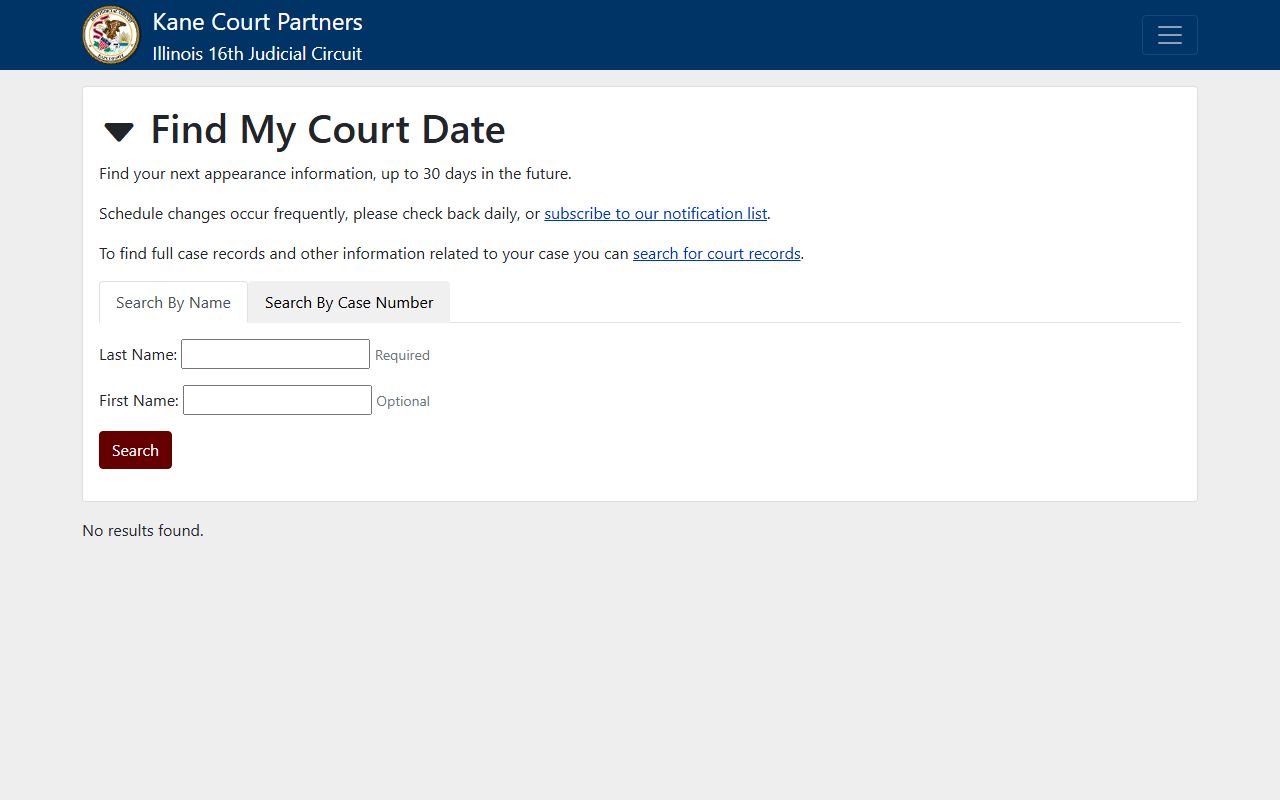
The court-date search lists upcoming appearances; for older events, a disposition, or a certified copy, the full Smart Search or the clerk's office is the right route.
| Field Label | Type | Required | Notes |
|---|---|---|---|
| Smart Search - party name | Text | Yes for name search | Last name first; exact spelling required. |
| Smart Search - case number | Text | Yes for case search | Four-digit year + case type + number, e.g. 2024MR3. |
| Court-date - Last Name | Text | Yes | Required for the name search. |
| Court-date - Case Number | Text | Yes for case mode | Finds appearances up to 30 days out. |
How Charges Get Filed After an Arrest: Complaint, Information, and Indictment
The arrest does not set the charges in stone. Booking happens at the jail, then the charge record truly begins when the prosecutor files a charging document. Three kinds open a criminal case in Illinois, and the choice depends on the level of the offense.
| Complaint | Information | Indictment | |
|---|---|---|---|
| Filed By | Officer / Prosecutor | Prosecutor | Grand Jury |
| Common For | Misdemeanors | Many felonies | Serious felonies |
| Starts | The case or a warrant | The case | The case |
A served probable-cause warrant can also start the custody side. Kane County tracks new filings on a SAFE-T Act dashboard that records initial appearances in courtroom 005 and whether the State sought to detain.
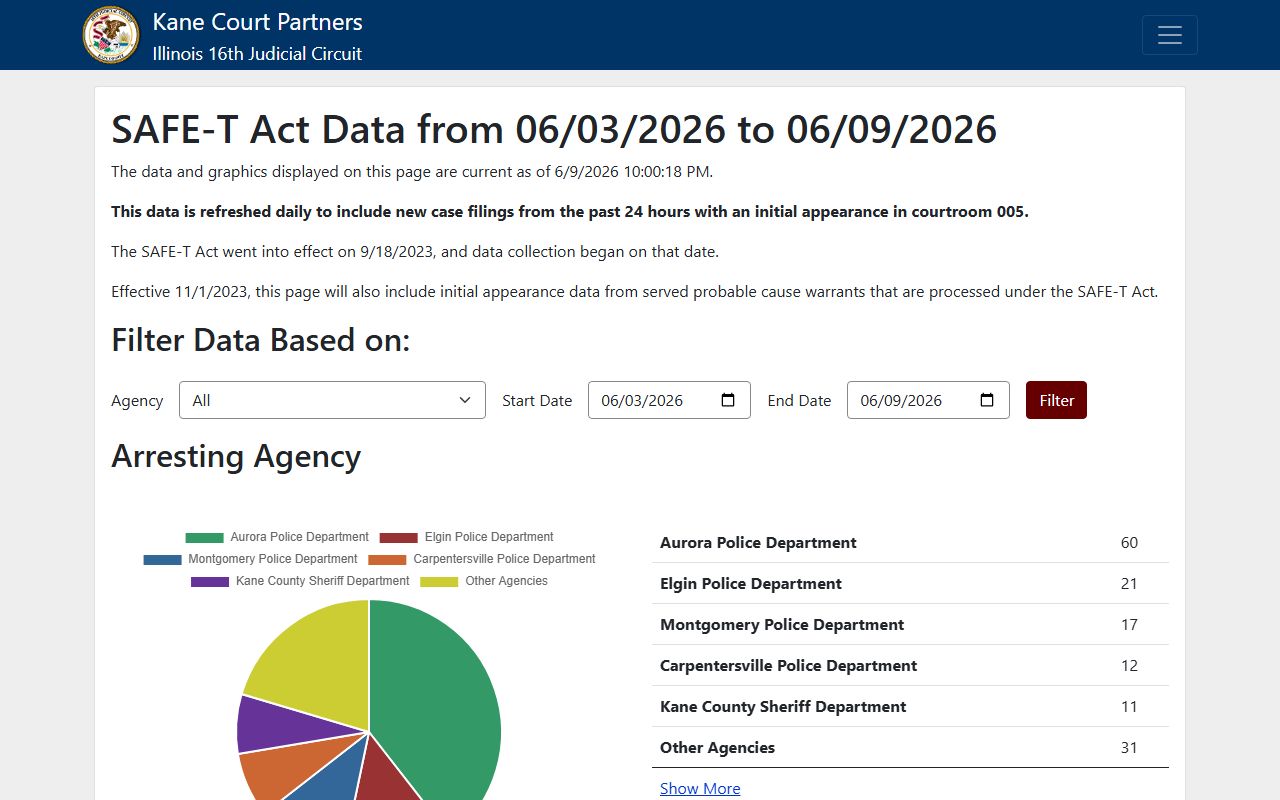
That dashboard is aggregate data, useful for understanding the arrest-to-court pipeline, but it is not a tool for looking up one defendant's court record.
Charge Status and What It Means
Charges shift as a case moves. The prosecutor can amend, reduce, add, or drop counts, so the booking charge on the jail roster may differ from the charge finally filed in court. The court record, not the roster, is the authority for the current charge.
| Status | What It Means |
|---|---|
| Pending | The case or charge is open and has not reached a final result. |
| Amended / Reduced | The State changed the charge or lowered it to a lesser offense. |
| Dismissed | The charge ended without a conviction. |
| Nolle Prosequi | The prosecutor chose not to pursue the charge. |
Bond and Release After an Arrest
Illinois ended traditional cash bail for new cases under the Pretrial Fairness Act, so a judge now decides release or detention at the first appearance rather than setting a fixed cash amount. Even so, the jail still processes bond in matters where one applies, and holds from other agencies can block release after any payment.
| Type | How It Works |
|---|---|
| Cash Bond | Exact cash, accepted 7:00 a.m. to 10:30 p.m., 365 days, with positive ID. |
| Card Bond | Handled by CourtMoney; overnight payments process after 7:00 a.m. |
| Pretrial Release | A judge sets conditions instead of cash under current Illinois law. |
| Hold / Warrant | Another agency's warrant or hold can keep a person in custody after bond. |
A 100 dollar processing fee applies on top of any bond and is not refundable. The sheriff checks for outstanding warrants before release, so a detainee with a warrant, an IDOC hold, or an ICE hold can be bonded yet still held for transfer.
Warrants That Lead to an Arrest
Kane County does not publish a searchable active-warrant list in the official sources reviewed. The Circuit Clerk says a person can learn whether a warrant or body attachment was issued against them only by reviewing the court file in person at the clerk's office. A motion to quash or recall a warrant can be filed at no cost, but filing alone does not stop an arrest until a judge signs the order.
The sheriff's Civil and Warrants Division handles service and execution of warrants directed to the office.
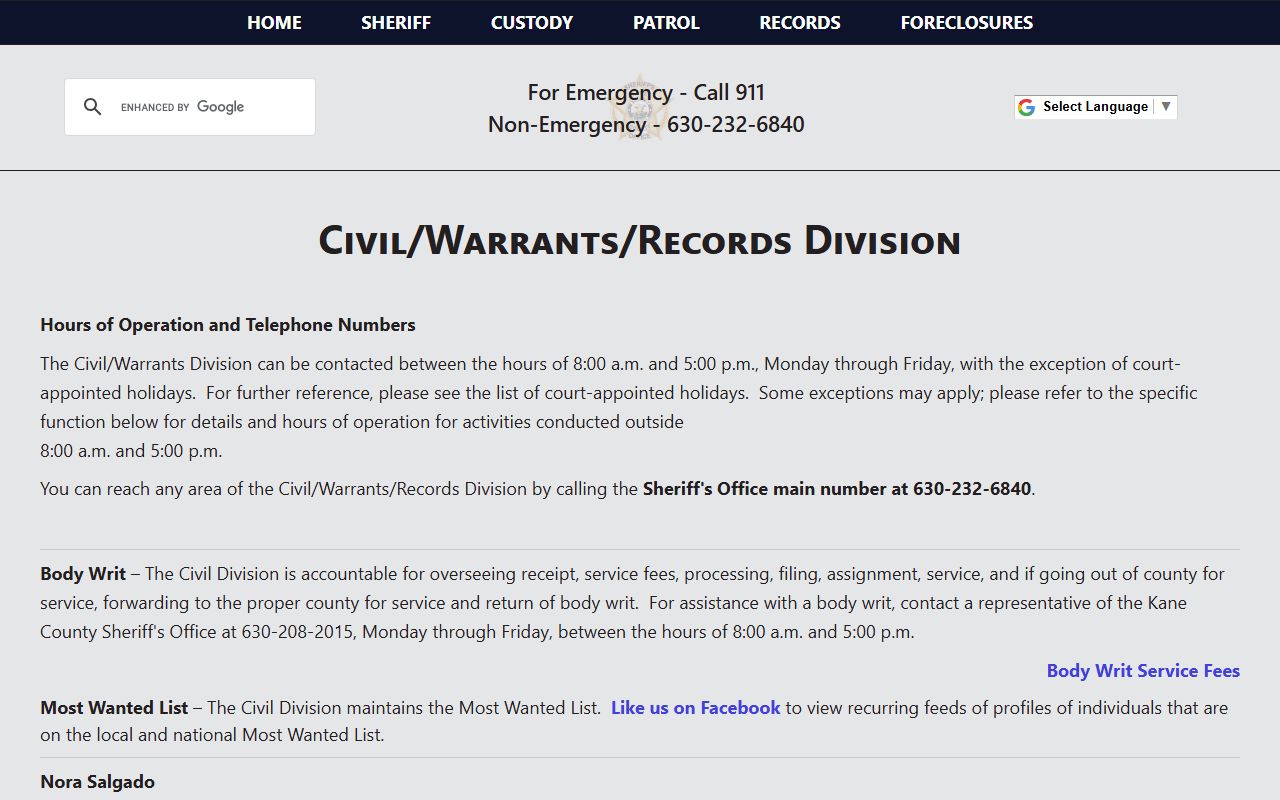
For warrant questions the division's body-writ line is 630-208-2015, open weekdays. An outstanding warrant authorized under 725 ILCS 5/107-9 is what often brings a person into the jail in the first place.
Charges vs. Convictions
An arrest and a charge are accusations, not findings of guilt. A conviction comes only after a plea or a verdict. The difference matters for anyone reading a court record, because a pending or dismissed charge is not the same as a conviction.
| Charge | Conviction | |
|---|---|---|
| Stage | Accusation | Verdict or plea |
| Burden of Proof | Probable cause | Beyond a reasonable doubt |
| Public Record | Yes | Yes |
Supervision is a common Illinois outcome that is not a straight conviction in many contexts, so read the exact court language rather than assuming.
Sealed vs. Expunged Court Records
After a dismissal or an eligible outcome, Illinois law lets a person seal or expunge qualifying records. Sealing hides a record from most public view, while expungement removes it. Both follow a court petition under the Criminal Identification Act, and the public portal may not show a record once relief is granted.
| Sealed | Expunged | |
|---|---|---|
| Visibility | Hidden from public | Destroyed or treated as never existed |
| Law Enforcement | Limited access | Very limited access |
| Eligibility | Set by 20 ILCS 2630/5.2 | Set by 20 ILCS 2630/5.2 |
The Circuit Clerk lists an expungement or sealing petition fee of 234.99 dollars, which includes a state police fee. Juvenile expungement carries no fee.
Court Copy Fees and Record Searches
The clerk's fee schedule, effective at the end of 2025, sets the cost of copies and searches. Online viewing is free, but a printout or a certified copy carries a fee, and a name or year search has its own charge.
| Item | Fee |
|---|---|
| First page copy | 2.00 dollars |
| Pages 2 through 20 | 0.50 dollars per page |
| Page 21 and after | 0.25 dollars per page |
| Record search | 6.00 dollars per year or name searched |
For certified copies, use the fee schedule rather than assuming an online printout is certified.
Background Check Considerations
Court records are public, but using them to screen people is regulated. A formal background check for hiring, housing, or credit must follow the Fair Credit Reporting Act and use a licensed agency, not a casual lookup.
Important: this is a private reference site, not a consumer reporting agency, and its information may not be used for any FCRA-covered screening decision.
Restricted Court Records After an Arrest in Kane County
Not every record after an arrest is open. Juvenile court records are generally sealed under 705 ILCS 405/1-8 and are not searchable on the adult portal. Sealed and expunged adult charges drop out of public view, and some sensitive or ongoing matters may be withheld. When the portal cannot find a case by exact spelling, the clerk's office can check the file directly.
Victims have their own channel into the process. The State's Attorney's victim services unit helps with notifications and compensation, and Illinois VINE lets a victim or family member register for alerts when custody status changes. Jail staff can release a next court date but not a full case history, so for anything beyond the next hearing the court file remains the authority.